A new viral video posted on MindStir Media's official YouTube channel shows Tom Arnold, Hollywood star and comedian, recommending that authors check out MindStir Media for self-publishing.
“A lot of great people are using it. It’s a quality company. They’ve won awards, I’m not even kidding. And they can expertly produce an eye-catching, high-quality book and market it …” Tom Arnold stated in the selfie style video. “MindStir Media, these are quality people. You get a good-looking book …" He held up a copy of his own published book. "It will change your life, I can promise you that. Check out MindStir Media.” As a self-proclaimed "huge fan of self-publishing," Tom Arnold is a big believer in using MindStir Media for self-publishing a book.
Tom Arnold’s career spans decades. He has been in major films and television shows like Austin Powers, True Lies, Nine Months, The Best Damn Sports Show Period, Trailer Park Boys, Sons of Anarchy and much more.
CEO of MindStir Media, J.J. Hebert raved about the endorsement: “Tom Arnold is one of the most recognizable names in Hollywood and in comedy. To have Tom recommend MindStir Media as an option for self-publishing authors is incredibly exciting. I’ve always enjoyed his acting performances, and his book of course, so it’s a dream come true to get his stamp of approval.”
MindStir Media is an award-winning self-publishing company partnered with Mariel Hemingway and Shark Tank’s Kevin Harrington. MindStir helps authors at every stage of book self-publishing, from book design to editing to book printing and marketing. J.J. Hebert founded the company in 2009 to self-publish his own book, Unconventional, which went on to sell over 100,000 copies in multiple formats. Hebert has since helped thousands of authors through MindStir Media, and he has appeared as a self-publishing and business expert in major publications such as Forbes, Entrepreneur, Business Insider and Yahoo Finance, to name a few.
MindStir Media has also received video endorsements from Shark Tank's Kevin Harrington and actress and bestselling author Mariel Hemingway, the granddaughter of Ernest Hemingway.

Friday, October 8, 2021

Friday, June 12, 2020
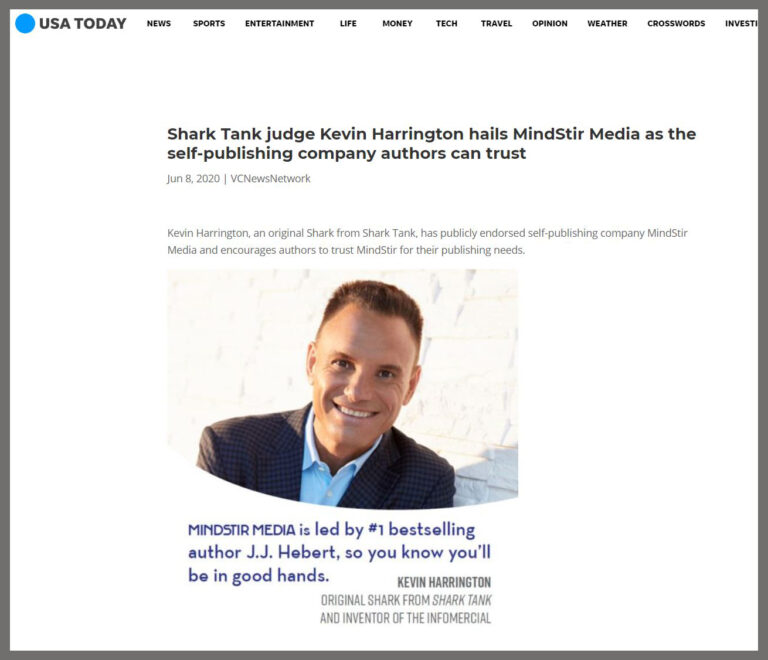
MindStir Media featured on USA Today: Shark Tank judge Kevin Harrington hails MindStir Media as the self-publishing company authors can trust
MindStir Media was recently seen on USA Today with regards to Shark Tank's Kevin Harrington praising our company as the self-publisher authors can trust.
Monday, April 13, 2020
Kevin Harrington, original Shark from Shark Tank, recommends Mindstir Media for your self-publishing needs
Last month, Kevin Harrington endorsed Mindstir Media. Mr. Harrington is an original Shark from ABC's hit TV show Shark Tank. Here's the full video:
Monday, August 5, 2019
Mindstir Media News - July 2019
Mindstir Media was quite busy in July 2019. Mindstir received its 16th book award in 10 years; one of Mindstir's authors won an author of the year award locally; and one of Mindstir's books became a #1 Amazon bestseller. Check out the news stories below to read more.
-Top book publisher Mindstir Media garners positive reviews & receives its 16th book award in 10 years: Source: One World Herald
-Mindstir Media author wins author of the year award, garners rave reviews: Source: Big Time Daily
-"Naschash's Narrative" by Volker Fremuth (from Mindstir Media) becomes #1 Amazon Best Seller and #1 Hot New Release: Source: Big Time Daily
-Top book publisher Mindstir Media garners positive reviews & receives its 16th book award in 10 years: Source: One World Herald
-Mindstir Media author wins author of the year award, garners rave reviews: Source: Big Time Daily
-"Naschash's Narrative" by Volker Fremuth (from Mindstir Media) becomes #1 Amazon Best Seller and #1 Hot New Release: Source: Big Time Daily
Tuesday, July 16, 2019
MindStir Media Self-Publishing Review - #1 Amazon Bestselling Author Volker G. Fremuth
Volker G. Fremuth recently became a #1 Amazon bestselling author. Below is a video in which he shares his experience with MindStir Media.
Thursday, July 11, 2019
MindStir Media Self-Publishing Review - Danielle DiPietro Hawkins
Danielle DiPietro Hawkins is seen here describing her self-publishing process and experience with MindStir Media.
Tuesday, June 25, 2019
Top 5 Book Awards for Self-Published Authors

As a self-published author, it can be difficult finding reputable book award competitions to enter. Many of the most prestigious book awards have rigorous entry rules and requirements not suitable for self-published books. To help aid in your search, and for your convenience, I've compiled a list of what I believe to be the top 5 book awards for self-published authors. I'm the award-winning author of three #1 Amazon Best Sellers (and publisher of over 500 books) -- and my recommendations below are based on my own research and experience.

1.) Manhattan Book Awards: The Manhattan Book Awards competition is open to USA and international authors with books tied to 50+ categories. The award strives to honor and showcase the best books that the world of publishing has to offer. Open to both self-published and traditionally published books. No publication date restrictions. Entry Fee: $125 per title or $99 per title (early bird price). Learn more and enter here.
 2.) IBPA Benjamin Franklin Awards: The Benjamin Franklin Awards is part of the Independent Book Publishers Association, the largest not-for-profit trade association of independent publishers. They accept books published by all methods including self-publishing. Over 50 categories from which to choose. $225 entry fee for first title, which includes one-year of membership to IBPA. IBPA member: $95 per title. Learn more and enter here.
 3.) National Indie Excellence Awards: The National Indie Excellence Awards (NIEA) is open to all English language printed books available for sale, including self-published authors."NIEA is proud to be a champion of self-publishing and small independent presses going the extra mile to produce books of excellence in every aspect." $75 entry fee multiplied by the number of categories entered. Learn more and enter here.

5.) AXIOM Business Book Awards: The Axiom Business Book Awards is the largest and most respected critical guidepost for business books in today's new world of publishing. Over 20 business categories to pick from. $75 entry fee per category. Learn more and enter here.
Disclosure: Bear in mind that some of the links in this post are affiliate links and if you go through them to make a purchase I will earn a commission. Keep in mind that I link these companies and their products because of their quality and not because of the commission I receive from your purchases. The decision is yours, and whether or not you decide to buy something is completely up to you.
Subscribe to:
Posts (Atom)